Floorball drills and practices 3-0, 4-0, 3-2, 4-2, 4-3 and 2-0

Salibandy pelitilanteet ja harjoitteet 3-0, 4-0

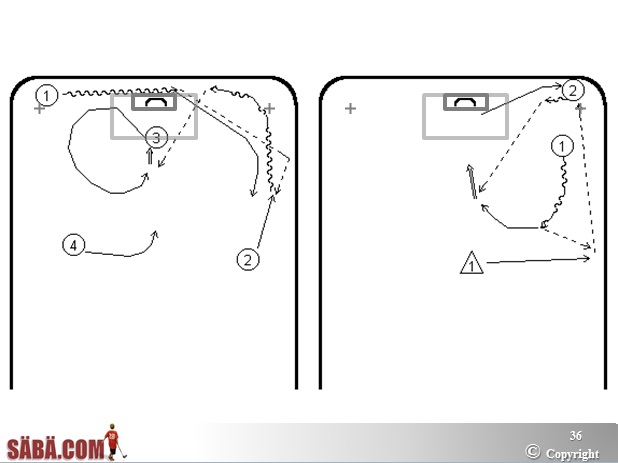
3 vs 0 Floorball practice to left

In the floorball drill to the right P1 starts running with ball from the corner, P3 leaves his/her position in front of the goal, and meets P1. P1 continues his/her running behind the goal and passes the ball to P2. P2 runs with the ball towards the short end, P1 takes P2 position. P2 passes the ball to P3 who has returned back in front of the goal. P3 shoots the ball into the goal. P4 is not part of the drill if you practice it 3 vs 0.

Add a pass to the floorball drill

After a while you can add a pass in this drill, when P2 meet P1, P2 passes to P1, P1 passes to P3, P3 takes the shot on goal.

Change the 3-0 floorball practice

Or P1 does not pass the ball to P3, instead P1 turns around and takes the shot, P2 and P3 are in front of the goal to pick up rebounds.

4 vs 0 floorball practice to the left

You perform the floorball drill as described in the first step, but you add P4 as one option for the pass from P2, the shot will then come from P3 or P4.

Change the floorball drill to a 3-2, 4-2 or 4-3 situation

Add two or three defensemen to the floorball practice drill to get a 3-2, 4-2 or 4-3 situation. The defensemen will follow players 1, 2 and/or 3.

2 vs 0 floorball practice (left)

You can also make a 2-0 situation of this floorball practice. In that case you do the floorball drill as the drawing shows until the pass to P2. After P1 has made the pass he/she turn around and goes behind the goal the sam way he/she has come, P2 passes the ball to P1 in front of the goal. P1 shoots the ball into the net. If you do the practice this way P3 and P4 are not included at all in the floorball practice.

Floorball Coaching Communication Skills

Every experienced floorball coach can tell you about leadership tricks that they have learned over the years as floorball coaches. They’ll tell you about how they motivate their floorball players, how they establish discipline and rules and most of the floorball coaches will even be able to give you a few tricks about how to deal with the referees. When they are done, you’ll be left with one conclusion, most of what they are discussing comes down to communication. The José Mourinho Signs - Learn to understand body language Good floorball coaches communicate well, what a concept! 😉 You’d think that this would be obvious, but so many floorball coaches, not just floorball coaches, coaches in other sports struggle with this as well, on a regular basis. Many coaches think that they ought to automatically get respect in their role as a coach from their players and the game officials, but like most things, they have to learn to earn it. Good communication skills will accelerate this process. Take a look at the leadership model this can be applied on communication as well or the body language material

Smart Youth Floorball Players

Smart and well trained floorball players are a floorball coaches best assets. Well-conditioned smart floorball players will beat less intelligent, yet bigger and stronger players almost every time! If a floorball coach trains the minds of his floorball players while he is drilling them, he will be rewarded in the long run.
The best time to engage your floorball players’ minds is when you are drilling their bodies. This goes like a hand in a glove with the idea of keeping your drills fun and challenging (a post couple of days ago)!

Multidimensional floorball practices and drills

Work on several things at once in your floorball drills (multidimensional practicing), but get the basics in place before adding more dimensions to the floorball drills.
While the assistant coaches are observing technique performance, a smart head coach will be drilling his floorball players minds, teaching them game situations, preparing them to think for themselves when the time comes. Never waste an opportunity to succeed, and make a point of never wasting time.

Floorball practice warm up

Why this floorball drill or practice?

Know why you are running the drill! You can use the leadership model on this page and apply it on your drills and practices (why, goal, how, result and feedback). Don’t just find some floorball drill in an old floorball coaching manual and decide that you can waste twenty minutes on it at the next practice. Locate floorball drills that will improve what your players have been doing poorly or strengthen even more what you are strong in. If your players are making poor tactical decisions during the floorball games, find floorball drills that will teach them to think about that specific game situation. There is no sense in running them through another floorball drill that teaches them something that they already know by heart.

The floorball drills found on this page are created to develop your players’ skills in game like practices and drills.

So, keep your floorball drills fun and challenging, keep your players focused and challenge them to think ahead. Do this, and you will be a successful, floorball coach!

Floorball – Correct Mental Pictures – Mental Training

Our brain is amazing

Eonverye taht can raed tihs rsaie yuor hnad… not all of us can, but most… and if you can’t, you’re still normal ; )

Icdnuolt blveiee taht I cluod aulaclty uesdnatnrd waht I was rdanieg. The phaonmneal pweor of the hmuan mnid, aoccdrnig to a rscheearch at Cmabrigde Uinervtisy, it dseno’t mtaetr in waht oerdr the ltteres in a wrod are, the olny iproamtnt tihng is taht the frsit and lsat ltteer are in the rghit pclae.. The rset can be a taotl mses and you can sitll raed it whotuit a pboerlm. Tihs is bcuseae the huamn mnid deos not raed ervey lteter by istlef, but the wrod as a wlohe. Azanmig? Yaeh, and I awlyas tghuhot slpeling was ipmorantt!
Bring this along in your leadership, our brains are amazing and will create pictures of what we say, even if we don’t get the full, or fully complete picture.

No, no words in communication

Think about a moment where somebody is talking to you and you felt all the energy was gone at that moment, or afterwards. Think back of the words that person used, could these have affected the loss of energy?

I think there are worlds that you can avoid in your communication, do you have some own examples of negative words?
For me the words must, always, don’t and never, are some examples that can kill the message, or give the wrong kind of thinking. You can try to put those words in a sentence and think of the reaction from the receiver, by thinking how you would react on the message.

You can also use the “but – word”, to kill your message. But can easily be changed to and, in many of the cases, like for example, and you can… compared to, but you can…

Let me give some examples of these negative destroying words, creating the wrong mental picture.

Don’t think of…

Don’t think of a yellow sour lemon, but I said Don’t think of a yellow lemon! How many times do I need to repeat it, Don’t think of a yellow lemon!

What happened, what were you thinking of? A yellow lemon? Most of us will or would.

Don't think of a lemon
Somehow our brains are built to sort out the important thing in a message (like in the example above, with the letters), but the “don’t part” usually falls out, and we think of a yellow lemon.

Don’t hit the post, don’t hit the post… You know the result…

 Feelings vs. Facts

When you are up to take the penalty shot you need to control your stress level, feelings and thoughts (more of this in the feedback section later). You can also try to visualize the facts, in order to control the feelings and thoughts, did you know that to cover a football goal (soccer) you need 10 footballs above each other and 31 beside each other, meaning you need 310 footballs to cover the whole goal. You have 310 spots to shoot the ball into the goal.

Basketball example

If you ask somebody who is not that familiar with basketball, how much space there will be left outside the ball when it goes into the basket, by the way, what would you answer?

How many centimeters or inches round the ball do you think there is left?

Basketball basketBasketball in a basket

Of course there has been research done in this area. There were two teams of young people, the first team were looking up to the basketball basket and could start to throw their basketballs. The second team had a basketball basket on their level and they could feel the size, feel it, and also try to fit themselfes in to the basketball basket ring and they could see how much space there where left around the ball. After that they started to throw the basketball into the basket.

I think it’s already quite obvious which of the teams performed better. Team one with a self created or given negative mental picture? Or team two with realistic fact based positive image?

I will give you the right picture as well. The answer is that, you can nearly get two basketballs (at least in women’s size) in to the basket at the same time.

Basketball in basket from aboveBasketball basket

That was not the picture you had in your mind, right? Quite a difference between these two images? You can imagine how easy it will be for you the next time you play basketball, or imagine the effect on our players when they have the right picture and are not steered by negative thoughts and feelings when they start a new drill, practice or work towards a common goal. Everything is possible, use facts to beat your negative feelings and thoughts and work with changing negative to positive, what if, to why not?

Mental homework

This could also be a homework for your floorball players, that they try to change their own negative thoughts they are facing in other situations outside floorball to positive thoughts. They need to practice these skills as much as technichal skills with a ball. If you want to be a champion you need to thin like one. Take the full responsibility for your own thoughts, there aren’t room for negative thoughts. Your thinking drives your behaviour and actions and these will form the performance. What about you as the leader?

Positive or negative touch on your message?

Choose your words wisely. You can say things in a negative way or in creative positive way. Why tell your players how they should not do things or what they should avoid, when you can choose to talk about how they should do, and what opportunities they have. Words you say as a leader affect your floorball players, their mental pictures and the culture within the floorball team.

If you throw something in to the water, you can see the rings it will create on the water surface, so chose carefully what the things are, you “throw” in to your floorball team. Each action, word, behavior, attitude, relationship counts within the team, in order to be successful, each of these actions will be spread amongst the team one way or another.

Words coming from you mouth, will create the pictures in your players heads and also the words coming from their mouths, you strengthen what you talk about positive or negative, and you are the one making the choice between these two alternatives!

Focus should be on what to do, not on what you should avoid doing.
Floorball Warm Up Practice – Attack and Defense

Salibandy lämmittely harjoite / harjoitus ja harjoitteet

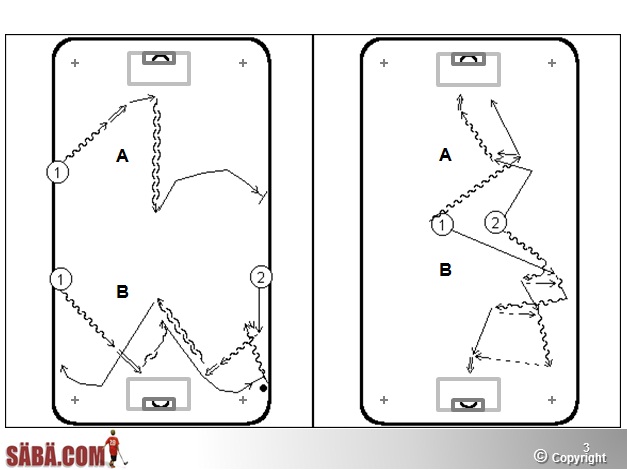
Floorball warm up practice up to the left (a)

This is a combined floorball practice drill, where P1 starts from the border and takes a shot, after that he/she works with defense, running backwards in middle and finally checks / steers the imagined breakout towards the other border. This pattern can be used if you are playing with 2-2-1 or for example 1-3-1 set up.

Floorball warm up practice up to the left (a), change it to a 1 vs 1 drill

Make the floorball drill to 1 on 1 practice by using P1 as passive defensive player against P2. P1 will only mark his/her presence and let P2 pass to make a shot.