
2-1-2 set up / system in floorball visualized in practice (division 1 in Sweden).
Read more or see theoretical pictures of 2-1-2 set up / System in floorball >>
2-1-2 set up / system in floorball visualized in practice (division 1 in Sweden).
Read more or see theoretical pictures of 2-1-2 set up / System in floorball >>

1-2-2 floorball set up visualized in practice. Picture from a division 1 game in Sweden.
Read more about 1-2-2 floorball system / set up >>
Motivation and attitude to a floorball practice or game is crucial for success. You can for instance rarely (if ever) change the external conditions before a game or training/practice, soft/hard floorball field, cold/hot weather, a long journey to away games, late/early start of the match (lunch or lasagna games in Italy), big or small floorball arenas, etc., but you can change/affect your mind and attitude of how you deal with these situations, you can learn to accept and deal with the situation and see it as a strength for yourself or for the whole team (assuming that the other teammates also are capable of dealing with the situation this way).

There is a model, for attitudes importance in sports/floorball/work etc. on a scale of 1 to 5, you value three areas, talent, ability (skills) and attitude. Based on a formula these three together create a theoretical performance result for the individual or group.
I will try to translate this into two examples, it could look like this. The first example is a floorball player with, a little more talent (4) than the average, he/she has also a bit more ability/skills to solve the task (4), but the attitude / motivation falters and is below average (2). In example two, we have an average good floorball player with the ability (3) and skill (3), but this player always perform well (good attitude and motivation), regardless of external conditions and can deal with these without affect on the motivation / attitude (5)
Floorball Player 1: (4 + 4) x 2 = 16
Floorball Player 2: (3 + 3) x 5 = 30
With these results it would be obvious who would win the game, but this is for indivual player motivation and performance, but connected to Steiner’s model you can work with it in a practical way. A good motivated team can beat an unmotivated skilled team on every level.
“When you play another team with the same qualities as you, normally the best one wins.” /José Mourinho
…If it wasn’t for the attitude / motivation part.
You or your floorball players can have all the talent in the world, or the best plans and targets to reach them (direction), but if you don’t have the energy and engagegement (why should I do something, what’s in it for me, what are the opportunities or threats), nothing will be done or it will not be done in the best way.
José Mourinho has openly complained about Karim Benzema’s attitude. During Real Madrids pre-season camp in the U.S. the question came up and Mourinho said that the 22-year-old must improve.
“Benzema needs to understand that he is extremely talented, but it is not enough. I need Karim. For me, it is important that the players throw themselves out. We need a striker who is glowing, not one that is completely without energy” /José Mourinho
“Remember what I said, this is an individual sport. Each player must take care of their own tasks, if the team will be successful” /Swedish hockey coach
“You need to remember that a team consist of individuals, that are cooperating with each other. The team itself will only exist if the cooperation is working well between the individuals” /Swedish hockey coach

What makes 100%? Here’s a little funny mathematical formula, that might help you answer these questions:
If:
A B C D E F G H I J K L M N O P Q R S T U V W X Y Z
is represented as:
1 2 3 4 5 6 7 8 9 10 11 12 13 14 15 16 17 18 19 20 21 22 23 24 25 26
then:
H-A-R-D-W-O-R-K
8+1+18+4+23+15+18+11 = 98%
and
K-N-O-W-L-E-D-G-E
11+14+15+23+12+5+4+7+5 = 96%
but
A-T-T-I-T-U-D-E
1+20+20+9+20+21+4+5 = 100%

In a 1-2-2 floorball system, for me the D2 player will be the most important both in defense, but also in building up your offensive plays.


If you have centrally strong opponent, you can try to pull in your players more centrally to force out the other team to the sides.

1-2-2 in V-formation will close the borders and force the opposite team in to the middle. Situations in the middle will be really tight and you need to be careful with the positioning of your teams players, be on the right side all the time between your own goal and your opponent.
Communication through all forms is central in life, floorball, coaching, leadership, and in many other areas, for me body language is a big part of communication. Therefore you will also find material about body language connected to leadership here on Flrball.com.
Some people, when they feel uneasy, will display a defensive body language by putting a barrier between them and the person or situation that is making them uncomfortable. Meaning the person / persons are keeping a distance and avoiding stepping into an others comfort zone.
This could also be shown in more physical things to build up the barrier like a chair, table, or even holding a package out in front of them making an obstacle between them and the perceived threat.
What do you think about this picture? It’s easy to spot there is one Real Madrid player (to the left) and to Barcelona players (to the right) by the body language of Christiano Ronaldo, Xavi and Lionel Messi.
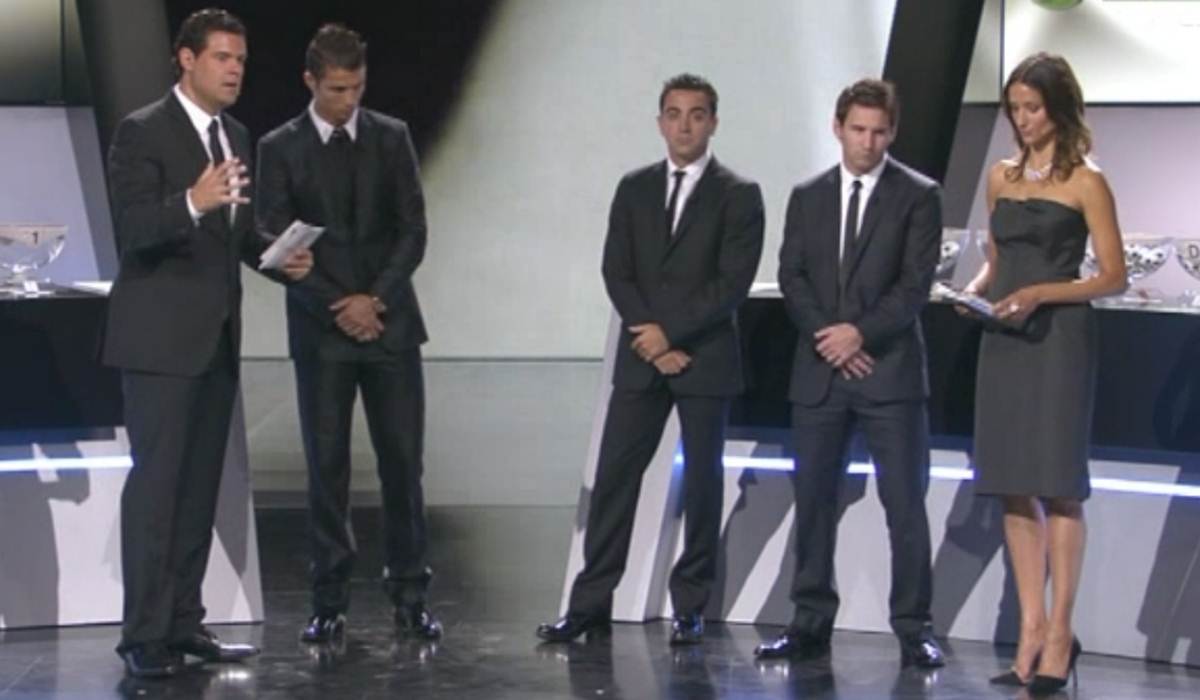
Have you tought about the body language you as floorball coach show, or what are the body language signals your floorball players are showing during a floorball game, confident, strong, weak, happy, winners, losers…?