Floorball drills and practices for 6, 7, 8, 9 and 10 year old

6-10 V. Pallonhallinta ja harhautus salibandyharjoite

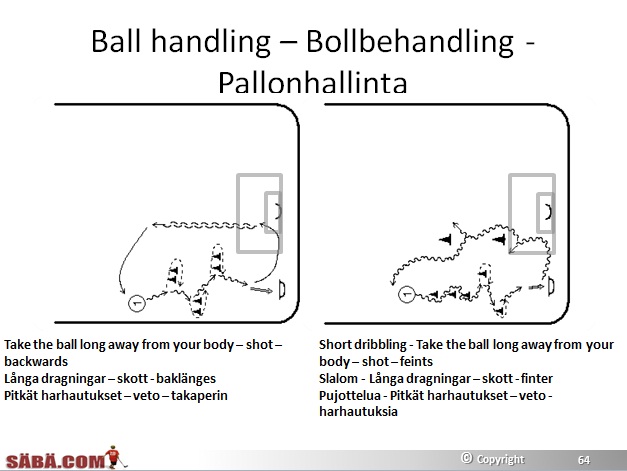
Floorball ball control / stickhandling drill for children / youth players – to the left

The floorball drill to left starts with the player taking a ball and making a long move to the sides, moving the ball behind the cones, this is repeated three times and after that the player takes a shot into the goal.

Make use of the way back

Usually the practices are ended after a shot, but I think it’s good to give your players missions or tasks to perform when they return to the starting position. In the floorball drill to left I have put in running backwards with the ball back to the que, but you can also make your players practice a feint / deke or their coordination skills.

Floorball and Hockey from a player perspective

If you have the opportunity or possibility to combine floorball and hockey practices as a player, I think you should do it, that’s my recommendation based on earlier posts. You as a player will benefit from it in both in hockey and floorball, since the two sports are very similar, requiring similar skills in stickhandling, game understanding, body contact, strength etc.

Hockey vs Floorball

Make the choice between the sports later, both floorball and hockey are fantastic games and can be combined and will strengthen your skills as a player in both sports.

Make the choice between the sports later, when you are older, depending on what you like or sometimes what you have the best skills for.

Floorball – For me or for someone else?

Internal or external motivation? The internal motivation comes from you, you do something because you want to (and you know why) and you can see the benefits for you. External motivation comes from for example external rewards, like prices, money or other benefits. It can be hard to tell what did motivate you most, but on the long term the internal motivation is the motivation that will help you most in your performance. Other sources for motivation might be:
– Task related motivation, comes from the teams goals and purpose, common efforts towards a common goal.
– Social related motivation comes from the social intercourse with the other team members
– Internal motivation comes from individual reward, goals and performance.

What is it that motivates us with a particular task. This may be some reasons:
– Social satisfaction
– Tournament moments
– Self-control
– Lifestyle
– Physical and mental wellbeing
– Success quest
– Money – survival – Luxury
– Status
– Competition
– (Nice view), See the Waterboy example in – For me, the team or why do I do it.
floorball reward

Rewards may increase motivation?

Yes answers, most people probably without thinking. So here’s a little story:
There was a group of boys who used to play football at a farmer’s field. The farmer himself did not like it and tried repeatedly to drive away those little football players, without success.
He decided to go for a new tactic. He walked up to the boys playing football and said that everyone would get 50 cents, each time they played football at his field. Next week, he gave them one Euro each. The week after he told the boys that he had short of money so they could only get 50 cents again. The next week he said he would only be able to pay 20 cents. The young football players were really upset, “Who do you think you are? How can you believe that anyone of us would play for you, for 20 cents?” So what the boys had done with joy and for fun (internal motivation), ended up as the farmer wanted, they quit playing after the external reward was minized or removed…

When a man comes home with flowers, the question might be “Okey, what have you done now, why do you bring me flowers? Or when you receive or are offered something for free, you immediately think “What do they want me to buy from them or what kind of subscription/contract is behind the gift”?
Rewards are good and fun, but you have to have the insight that people or your players perceive it very differently. Therefore, it is good to explain and justify carefully why you give the person something. Otherwise, some people get the feeling that the other person is trying to take control of me and tie me up by giving me something.

It’s good to have money, so you can buy things that can be bought with money. It’s although a lot better to not lose the things that cannot be bought with money. (It’s better to have internal than external motivation)
Floorball vs. Hockey from a coach perspective Part 3

Players coming from hockey to floorball are already on a very good level ragarding stickhandling and they are used to body contact, which is increasing in floorball, and the hockey players have also good “foot skills / foot work” from all different skating practices.

If you try to summarize what the two sports floorball and hockey can bring to ech other is;

Floorball to Hockey skills

– Stickhandling skills
– Early game understanding
– Passing skills

Hockey to Floorball skills

– Different type of stickhandling skills and practices
– New dimensions to the game understanding
– Strength and body contact
– Movement into the game

Common skills between floorball and hockey

– Passing
– Tactics
– Technical skills (like stickhandling)
– Game systems and set ups
– Shots

Hockey and floorball in cooperation

I personally and as a coach try to find the benefits between floorball and hockey instead of competition in the early ages. Floorball can develop hockey and hockey can develop floorball, you just need to have an open mind and co-operate and create contacts over these two sport borders, this will benefit both sports and the amount of players!

We can share the players and develop them together to be stars in either floorball or hockey in the end!

Floorball warm up drills – Short passes and shifting positions

Salibandy lämmittely harjoitukset - Paikan vaihdot ja lyhyet syötöt

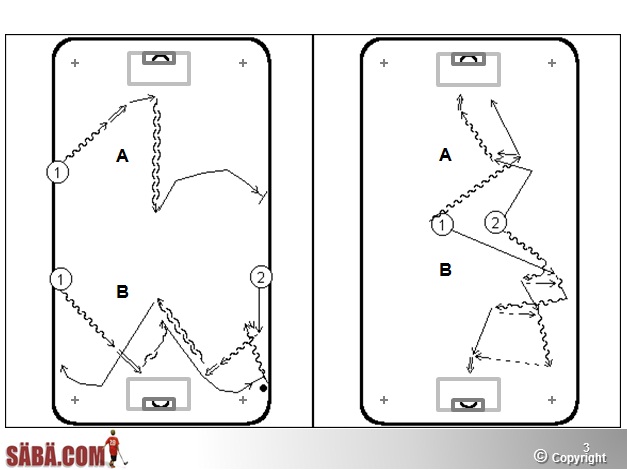
Floorball warm up drill – down to the right (b)

P2 starts the floorball drill with running with the ball towards the border, makes a turn towards the middle. P2 runs behind and receives a pass from P1. P1 transports the ball from the border towards the centre. P2 runs behind and receives a pass. P2 runs with the ball and passes it to P1 in front of the goal. P1 shoots the ball into the goal.