Floorball Communication and Body Language guidelines

Communication starts immediately in the first meeting with your team, players, new people, other floorball coaches, referees etc. the first impressions counts! Dress well, hold your head up high, look into their eyes when you are speaking, and always speak slowly and clearly. Treat everyone with the respect that you hope to earn or get back. (body language)

Floorball practices and drills for 6, 7, 8, 9, 10 years old

Listen when others speak and consider what they have to say before you respond. So you respond on the right thing. Ask questions as “receiver”, to secure that you have understood the message from the “sender”.
Make sure that you understand their point of view before continuing the conversation.  When you disagree, do so respectfully, clearly state your case and avoid repeating the same points over and over.

Floorball – Norms create team culture

If you look up the word, norm in Wikipedia, you will find the following explanation. Social norms are the behaviors within a society or group or, the rules that a group uses for appropriate and inappropriate values, beliefs, attitudes and behaviors. So the norms will affect both the direction within the team and the co-operation within the team.

Three categories of norms

You can divide norms in different categories, here are some examples.
– Describing norms – steers the behavior in the floorball team.
– Valuing norms – helps the team prioritize among wanted behaviors.
– Discrete norms – not visible when they are followed, but if someone breaks against a norm, it will be visible.
– Internalizing norms – These will be adapted by the floorball team members and new comers, and often live for a long time, therefore norms are also stable.
In order to develop, visualize and strengthen wanted norms, you can use teambuilding activities and feedback as your tools.
Norms are usually connected to behavior during practice, game, before/after regular season and social situations. One of the common norms in all of the teams will be the expectation of how hard you are expected to work during a practice or game.

Floorball thanks for the game

Norms within a group of monkeys

Here is an experimental example with monkeys and how they create, and handle norms within the group.
– There is a group of monkeys living in a big cage, the monkeys get bananas that are hanged up in the tree that’s located in their living area, after the bananas are hang up in the tree, one of the monkeys head up for the bananas, monkeys do that it’s natural : ), but when he does that all the monkeys are flushed down with water, they get really wet and that’s something monkeys don’t like. After a while a new monkey’s heads up for the bananas, with the same result, wet monkeys. After repeating this several times, the monkeys understand the message, they continue with theirs, without trying to get the bananas in the tree. A new monkey is placed in the cage and he immediately heads after the bananas, but before reaching there, he is stopped and beaten up by the other monkeys, because they know the consequences! Step by step all the “original” monkeys are changed to new team members. For every new monkey the same procedure is repeated, he heads after the bananas and get stopped and beaten up. Even if all the monkeys are changed to new “team members” they are still stuck to the norm, don’t touch the bananas in the tree, without knowing why, it’s just the way it is, and has always been. Do you recognize this in real life situations?

Norms tend to live for a long time

We are many times following rules, norms and guidelines because we think they make sense, but logic can sometimes be “old fashioned” and not relevant anymore, but the norms can create a culture within the team or club, positive or negative.
How does it look like in your floorball team or club? Is it clear why you do, or not do things or why people act in certain ways?
What kind of old norms does Jose Mourinho find in his new team, Real Madrid and what has he left behind in Inter for Rafael Benitez and now Leonardo?

Outspoken rules

If norms are more invisible, rules are more outspoken and visible. Rules can like the norms be divided into some categories, here are some examples.

– How or frame rules – framing in what’s okay and what’s not, in general.
– Priority rules – when you need to choose or make own decisions, you know the team priorities
– Time rules – eliminating co-operational losses

Mourinho’s rules in Real Madrid

When José Mourinho started his voyage with Real Madrid, you could read about some of his rules in the news papers.
– Don’t come late, I will not wait for anyone.
– Training begins 9:30. Those who come late are locked out from the rest of the team and get to practice alone.
– The bus leaves always on time. If a player is late, his left at home, even if it’s a minute’s delay.

“I’m not waiting for someone, even if it would mean, that we get to play the match with a man less” /José Mourinho

Injured players should arrive at the training ground an hour before training starts. After examination, the physician should then report to Mourinho about the situation.
The practice is always 90 minutes long. And the Real Madrid players should be prepared for a tough season. Hard workouts, but with a lot of ball involved.
And finally, mobile phones may be used also on the bus. But the signal must be on silent, so the rest of the squad is not disturbed by incoming calls.

Feedback to Benzema about following the teams rules

Spanish Marca writes that Mourinho repeatedly held talks with Benzema about discipline and the team rules. Last time Mourinho needed to upbraid him in front of the rest of the squad.
“If it was just for you, I would have the practice in the middle of the day, because you come here at ten, half asleep and at eleven, you have already fallen asleep again” / Mourinho

Did you know that a space shuttle uses more energy the first three minutes after a start, than during its entire voyage round the world? So make sure you have the right amount of energy and the right direction, when you start of, because you are fighting the forces of gravity like old behaviors, norms, thinking and habits. (See the category A. About Mourinho Leadership “The Model”, how each piece in the leadership model is connected to each other)
Floorball drills and practices 3-0, 4-0, 3-2, 4-2, 4-3 and 2-0

Salibandy pelitilanteet ja harjoitteet 3-0, 4-0

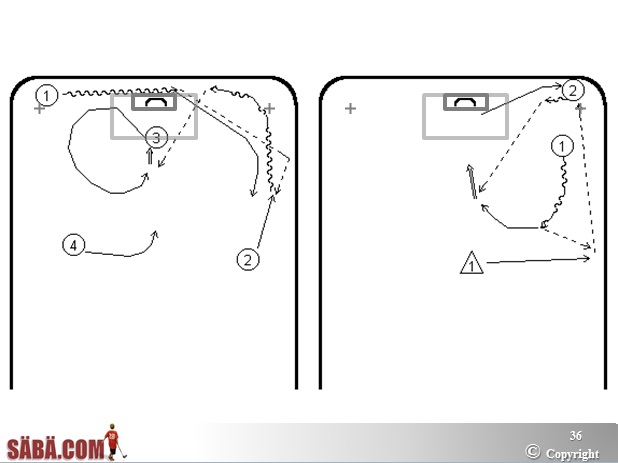
3 vs 0 Floorball practice to left

In the floorball drill to the right P1 starts running with ball from the corner, P3 leaves his/her position in front of the goal, and meets P1. P1 continues his/her running behind the goal and passes the ball to P2. P2 runs with the ball towards the short end, P1 takes P2 position. P2 passes the ball to P3 who has returned back in front of the goal. P3 shoots the ball into the goal. P4 is not part of the drill if you practice it 3 vs 0.

Add a pass to the floorball drill

After a while you can add a pass in this drill, when P2 meet P1, P2 passes to P1, P1 passes to P3, P3 takes the shot on goal.

Change the 3-0 floorball practice

Or P1 does not pass the ball to P3, instead P1 turns around and takes the shot, P2 and P3 are in front of the goal to pick up rebounds.

4 vs 0 floorball practice to the left

You perform the floorball drill as described in the first step, but you add P4 as one option for the pass from P2, the shot will then come from P3 or P4.

Change the floorball drill to a 3-2, 4-2 or 4-3 situation

Add two or three defensemen to the floorball practice drill to get a 3-2, 4-2 or 4-3 situation. The defensemen will follow players 1, 2 and/or 3.

2 vs 0 floorball practice (left)

You can also make a 2-0 situation of this floorball practice. In that case you do the floorball drill as the drawing shows until the pass to P2. After P1 has made the pass he/she turn around and goes behind the goal the sam way he/she has come, P2 passes the ball to P1 in front of the goal. P1 shoots the ball into the net. If you do the practice this way P3 and P4 are not included at all in the floorball practice.

Floorball Coaching Communication Skills

Every experienced floorball coach can tell you about leadership tricks that they have learned over the years as floorball coaches. They’ll tell you about how they motivate their floorball players, how they establish discipline and rules and most of the floorball coaches will even be able to give you a few tricks about how to deal with the referees. When they are done, you’ll be left with one conclusion, most of what they are discussing comes down to communication. The José Mourinho Signs - Learn to understand body language Good floorball coaches communicate well, what a concept! 😉 You’d think that this would be obvious, but so many floorball coaches, not just floorball coaches, coaches in other sports struggle with this as well, on a regular basis. Many coaches think that they ought to automatically get respect in their role as a coach from their players and the game officials, but like most things, they have to learn to earn it. Good communication skills will accelerate this process. Take a look at the leadership model this can be applied on communication as well or the body language material

Smart Youth Floorball Players

Smart and well trained floorball players are a floorball coaches best assets. Well-conditioned smart floorball players will beat less intelligent, yet bigger and stronger players almost every time! If a floorball coach trains the minds of his floorball players while he is drilling them, he will be rewarded in the long run.
The best time to engage your floorball players’ minds is when you are drilling their bodies. This goes like a hand in a glove with the idea of keeping your drills fun and challenging (a post couple of days ago)!

Multidimensional floorball practices and drills

Work on several things at once in your floorball drills (multidimensional practicing), but get the basics in place before adding more dimensions to the floorball drills.
While the assistant coaches are observing technique performance, a smart head coach will be drilling his floorball players minds, teaching them game situations, preparing them to think for themselves when the time comes. Never waste an opportunity to succeed, and make a point of never wasting time.

Floorball practice warm up

Why this floorball drill or practice?

Know why you are running the drill! You can use the leadership model on this page and apply it on your drills and practices (why, goal, how, result and feedback). Don’t just find some floorball drill in an old floorball coaching manual and decide that you can waste twenty minutes on it at the next practice. Locate floorball drills that will improve what your players have been doing poorly or strengthen even more what you are strong in. If your players are making poor tactical decisions during the floorball games, find floorball drills that will teach them to think about that specific game situation. There is no sense in running them through another floorball drill that teaches them something that they already know by heart.

The floorball drills found on this page are created to develop your players’ skills in game like practices and drills.

So, keep your floorball drills fun and challenging, keep your players focused and challenge them to think ahead. Do this, and you will be a successful, floorball coach!