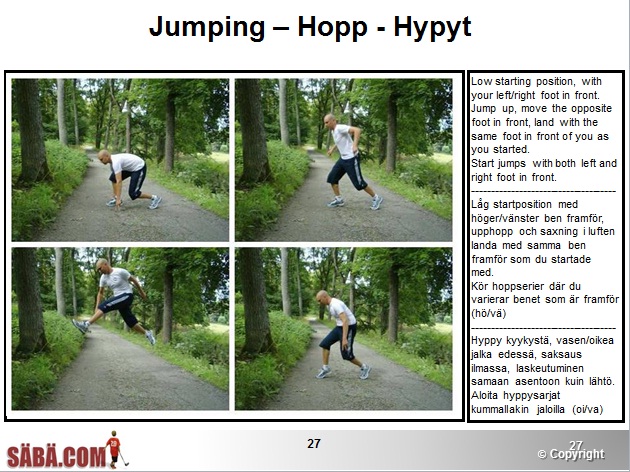
Off-season practice to floorball. The floorball off season jumping drill is started in a low position with one foot in front of the other, then a jump up and you switch the position of your feets, but land as in the starting position.
Off-season practice to floorball. The floorball off season jumping drill is started in a low position with one foot in front of the other, then a jump up and you switch the position of your feets, but land as in the starting position.
At the beginning of the floorball season every coach meets his or her new floorball players and analyzes their skill-set and knowledge of the game. Lets face facts, most floorball coaches know from the first day whether or not their team is going to be competitive or not, and it just as true that many coaches get frustrated on that very first day. A good floorball coach never lets his team see this frustration.

Focus on the positive! Speak to your floorball players about improvement. From the very first floorball practice, speak of learning skills and working hard. We’ve all seen the comedy routines about the impossibly naïve coach who keeps talking about having fun while his players are getting killed, but in the long run, aren’t sports supposed to be about having a good time while simultaneously building character?
Give your floorball team members goals, not instructions on how to reach them. Ask for their input and point of view. Give your floorball players room to act and therefore also space for creativity, within the frames. You don’t need to have all the answer, guide your players to answers inside themselves (e.g. Player: How should we do this? Coach: Do you have a good suggestion how to do it? Or, how would you like to solve it? Or, someone else, who has a good answer?) After starting the fire (why and what), avoid putting your fingers in to the fire (how), create the framework for the fire and trust your players.

“I use a global method, I use direct methods when preparing our organization, but I also use guided discovery where I create the practice, dictate the aim, and the players come up with different solutions” /José Mourinho
Magnifying glass.
Most of us has once owned a magnifying glass, have you? I have. The original purpose of a magnifying glass is to visualize the details or make the details bigger. Did you use the magnifying glass for something else? I did…
I assume that you have at least once tried to create a fire with your magnifying glass, when you were young? How can this be connected to (direction) your vision, goals and focused areas?
Your vision goals and focused areas should do the exact same work as the magnifying glass, catch the energy within the frames and focus it to a point to create fire.

One of the most important things, when talking about vision, goals and focused areas is communication. How can you secure that everyone has the same target image or picture as you want or how do you know the player have understood your message or seen the picture you try to “paint” out for them?
There will be a lot of things that will make the picture to differ between your floorball players, experience, expectations, their own will, the language you are using including your body language and many other things. Therefore it’s important that you somehow get a receipt of their understanding and interpretations. If you also allow you players to comment or maybe add things to your vision, focus or goals, you will immediately get a stronger buy in from each and one of the players.
Why should you have a vision? The vision will give you guidance in your leadership, coaching, daily decision making, acting and communication.
When you talk about a vision, you and I might have different pictures in our heads. I will try to give you my picture. For me to start with a vision can be in whatever format, only your own fantasy can limit it. It can be everything between some bullet points on a paper to a short movie “from the future”. So the format is not that important, but how it’s perceived, it should create energy and direct it on the long term, and to be honest how exciting are some bullet points, even if they would do the work?
A vision can be a colorful multi-dimensional description of what you as the leader see in the future, you can in your own mind/head try to move couple of years into the future and describe what you see, feel, hear, regarding the team, achievements, team spirit, players, club, fans, results, behavior etc. A good way to describe what has happened in the future is to actually try to describe it as it would have happened, not in, should terms. Because as you have read earlier the pictures you create are important (sour lemon or basketball example). There is one more dimension to ad, our brains can not make difference between created realistic pictures and realistic pictures, the difference comes from our own values and belief…
I try to visualize the difference for you.
Vision 2014
– We should win the league 2014
– We should improve our team-spirit
– We should increase the intensity in our practices
– We must… etc.
Or…
8th of May 2014
I would like to welcome you all to this press conference. I can imagine you have a lot of questions after our victory in the League. If I just start to give you my point of view of the key success factors, after that you will be able to ask some questions to the players.
To start with, I think our victory would have not been possible without the fantastic team spirit we have in our team, everyone has a clear defined role, and all of the players have accepted this during this year/these years, we don’t use the word “first teamers”, we are one TEAM.
During this year we have increased the intensity in our practices which we also showed clearly in yesterday’s last game in the league. We were the strongest team in the end, we were willing to run the extra mile, and if you look at the amount of goals we have scored this season, it’s 89 goals and that gives you also the picture of an offensive, strong and quick team!
The setup, could be that you actually rig a press conference with the players in the press role. Do you feel the difference between these examples?
After creating a vision it’s important to also involve your floorball players, what do they think? Is this the correct way? Don’t just accept an yes, ask questions, why do they think it’s the right way, or why not, what did they find exciting in the vision (and not, why?), was there something that needs to be changed, added or deleted? In the end you are of course the one deciding about changes, but if you don’t listen to your players, you need to explain why you will do that, why you will continue with your “picture”, but in that case are you walking alone towards the vision or do you have your team with you on the trip? I can say that if the vision is well taught throug, prepared and tested on a smaller group before the presentation, and it’s attractive, you will only get positive feedback and explanations why it’s correct and therefore the players also feel that the vision is also theirs. Otherwise you sometimes get good input that will complement the vision, things that you haven’t thought about or didn’t feel were important, but for the team it was. Even if you make some changes, you will still have the same buy in from your team, in this case maybe even more, because they have added something and you as the leader have showed them that their opinion counts, respect!
The same method applied on practices and drills.
“I use a global method, I use direct methods when preparing our organization, but I also use guided discovery where I create the practice, dictate the aim, and the players come up with different solutions” /José Mourinho
If you assume that the floorball teams on certain level practice the same amount of practices each week, lets say four times, and you want to outcompete your opponents, you can choose to increase the amount of floorball practices or work on improving the quality of your floorball practices and drills, in order to “run away” from the other teams.
Let’s have an theoretical example, 4 (floorball practices) x 31 (weeks, length of the season) = 124 floorball practices during a season. Each practice contains 5 floorball drills, 5 X 124= 620 drills. Each floorball drill is repeated 5 times per player during the floorball practice, 5 X 620=3100 repetitions.

Instead of increasing the amount of floorball practices you could set up a goal that each player will run 3 meters extra every floorball drill, this would mean 3100 drills X 3 meters X 20 players = 186000 meters. Your team would with this small improvement run 186 kilometers extra during the floorball season, the result should be visible in the end of the games or at the end of the season, you would have physically and psychologically strong floorball players, they will take the extra steps needed for success. Instead of running, you could let your floorball players practice a feint while waiting. 10000 repetitions will automatize the move, 10000 hours will make you master of it!

You can of course use the same principle for improvements in general or your work towards common goals. Let’s say you can do 3 small improvement steps each day, after a month you have 90 small improvement steps and after 6 months 540. If you can make each floorball player in your team to take these small improvement steps you will have 540 X 20 players = 10800 small improvements in your floorball team.