Floorball – Wanted position

I will talk about two ways of setting goals, or how to look at the goal setting process. The first one is about looking back on your performance and setting the goal little bit higher than the history shows.

If you are thinking about goal for the league position, you might look at your previous seasons 10 pos. 8 pos. 9 pos. and therefore you think a realistic goal should be 6 or 7 position, but you might to choose to raise it a little bit to position 5.

The second way to set goals is to take a step into the future and to think where you would want to be in the future or were you must be in order to achieve something. Let’s say your floorball team is in the next highest division. Maybe you have described in your vision that you want to be in the premier league (highest division), therefore you automatically must be top 2 or 3 in your division in order to be able to take the next step. This could create a conflict, if you have team members that are “stuck” in the history, they won’t think this is a realistic goal, and it might not be, it’s your wanted position in order to take the next step.

Floorball thanks for the game

If you are setting goals by taking a step into the future and pointing out a wanted position, you will create an information gap that needs to be explained for your floorball players. So the discussion should rather be about, if they want to be there, than if it’s realistic. After you have cleared out that, you can start to take small steps back from the future, if we want to be here, top 2 and advance a division. What changes do we need to do in order to achieve that? You need to slice the big block to small steps (We need to increase the amount of practices. We need to think about what and how we eat. We need to improve our defense.) When you have this discussion about many small improvements with your floorball players, you get a buy in on the goal and suddenly it starts to be realistic at least in every ones heads.

You can think about José Mourinhos challenge when setting a goal, that was to win the Champions League, when Inter had won it, last time in 1965, maybe it was more realistic if you look at other aspects than the historical performance, like the team members and Mourinho himself.

In short term goal setting you can use the same methodology, in order to support your long term goal and vision.
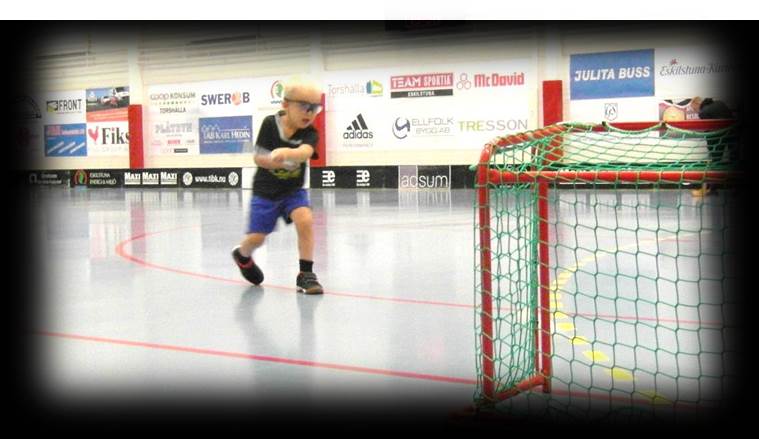
Floorball practice shooting drill

The last level defining a focus area will support you in achieving your short term goal (and long term goal and vision). What do we need to focus on as the first steps on our way towards our wanted position? This should of course be transferred to concrete actions and an action plan.

As a summary you can say that you can work with setting the direction on different levels, Vision – Long term goals – Short term goals – Focused areas – Actions/Action plan.

Floorball – Focus on the positive and improvement

At the beginning of the floorball season every coach meets his or her new floorball players and analyzes their skill-set and knowledge of the game. Lets face facts, most floorball coaches know from the first day whether or not their team is going to be competitive or not, and it just as true that many coaches get frustrated on that very first day. A good floorball coach never lets his team see this frustration.

Floorball game running and focusing on defense

Focus on the positive! Speak to your floorball players about improvement. From the very first floorball practice, speak of learning skills and working hard. We’ve all seen the comedy routines about the impossibly naïve coach who keeps talking about having fun while his players are getting killed, but in the long run, aren’t sports supposed to be about having a good time while simultaneously building character?

Floorball – Stress level affects focus and attention

Too high or low levels of stress/arousal will affect many areas, one of them is focusing. When you are talking about focusing, you can talk about optimal, broad or narrow focus.

Hockey vs Floorball

Let’s have a look at an example from the UEFA Champions League match between Inter and Bayern Munich.

Level of focus, Attention, arousal, stress, optimal, narrow, broad

1. Optimal attention field , with moderate or optimal arousal. (Lucio is able to see the opportunities for passes, but can also try to get past his opponent)

2. Too broad attention field, as a result of low arousal. (He can hear the crowd and his coach Leonardo, and has the focus on something else than the closest situation), can result in loss of ball possession.

3. Too narrow attention field, due to very high arousal. Limited to one option and it will be hard to perform it well due to too narrow focus (opponents feet) and tension in muscles.

What about the focus or attention in this picture (Bayern Munich defenseman and Inter’s Samuel Eto’o)?
Where focus Samuel Eto'o Inter Bayern Munich Champions League

Floorball vs. Hockey from a coach perspective Part 2

I’m today fully engaged as a hockey coach in a youth team and “partly” involved in different floorball asignments. What I can see is that floorball players playing hockey are mostly extremely skilled in stickhandling and they are also a head regarding game understanding, WHY? I think it’s simply because you don’t need to focus on learning skating. Therefore in floorball you can focus on stickhandling and game understanding at an earlier stage than in hockey, and as a hockey coach I’m greatly thankfull for that support from floorball to my players in my hockey team.
Hockey vs Floorball and team size